What Is The Best Bait For Barramundi In Cairns?
Live bait, dead bait or lures for barramundi around Cairns, what local charters actually supply, and the size and season rules that decide what goes on the hook.
What Is The Best Bait For Barramundi In Cairns?
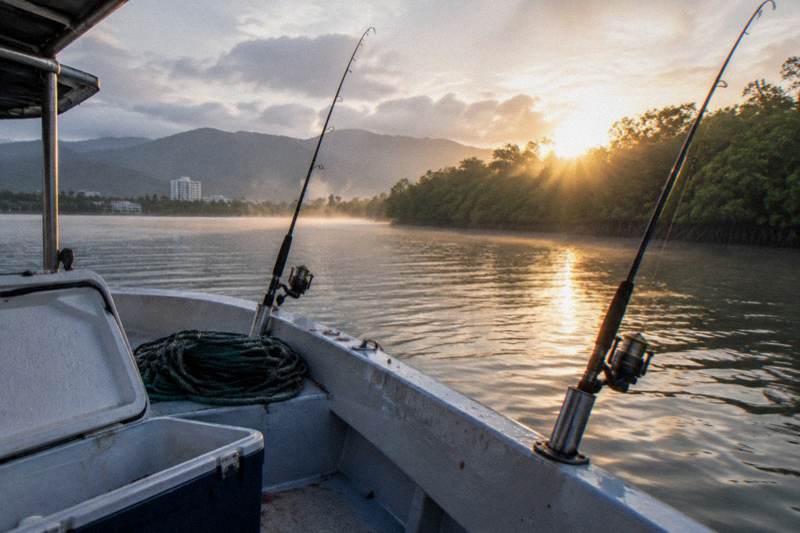
There is no single best bait for barramundi in Cairns, but live fish such as small mullet or live prawns are the strongest starting point in the estuaries, with fresh dead bait close behind and lures the better choice when fish are actively feeding. The right answer also depends on the season, the water and what your charter supplies, because a guided trip usually puts bait and tackle in your hands before you cast. If lures turn out to be the better option on the day, our guide to the best barramundi lures in Cairns covers soft plastics, hard-body minnows and surface options, along with the size limits and closed seasons you need to know.
Barramundi are an ambush predator. They sit in snaggy structure, in mangrove roots, around rock bars and along creek edges, and they strike at whatever swims past their face. That is why live bait works so well in the Cairns estuary systems: a live fish struggling on a hook near a snag does the advertising for you. A dead bait fished on the bottom near the same structure is the patient option, and a lure worked actively through the water is the option that lets you cover ground and find fish instead of waiting for them.
The choice between the three is not about one being universally better. It is about conditions. In dirty water after rain, when barramundi hunt by vibration and smell rather than sight, bait tends to outfish lures. In clear water on a building tide, a lure worked along a snag line can be deadly because the fish can see it and react. Local guides read the water first and pick the presentation second, and the same trip can switch from lures to bait within an hour as the tide turns.
The other part of the answer is practical. Most visitors fishing around Cairns do not bring their own bait, and they do not need to. The guided options on this site supply gear as part of the ticket: the morning estuary charter on Trinity Inlet includes rods, reels, bait and tackle in its AUD 150 per person price, and the Hook-A-Barra farm sessions at Wonga Beach include tackle and lures, with the one-hour listing also naming bait provided. If you are comparing ways to get a line in the water, these three are the natural starting points. Even with bait and tackle sorted for you, these fish do not make it easy, so it pays to read up on why barramundi are so hard to catch before you cast a line.
Live Bait Or Dead Bait: Which Works Better Around Cairns?
Live bait is generally the more reliable of the two around Cairns, because a struggling fish appeals to a barramundi's ambush instinct in the snaggy, tannin-stained water of Trinity Inlet and the local rivers. Dead bait still catches fish, especially fished near the bottom on a run-out tide, but it asks the fish to find it rather than attracting a strike from a distance.
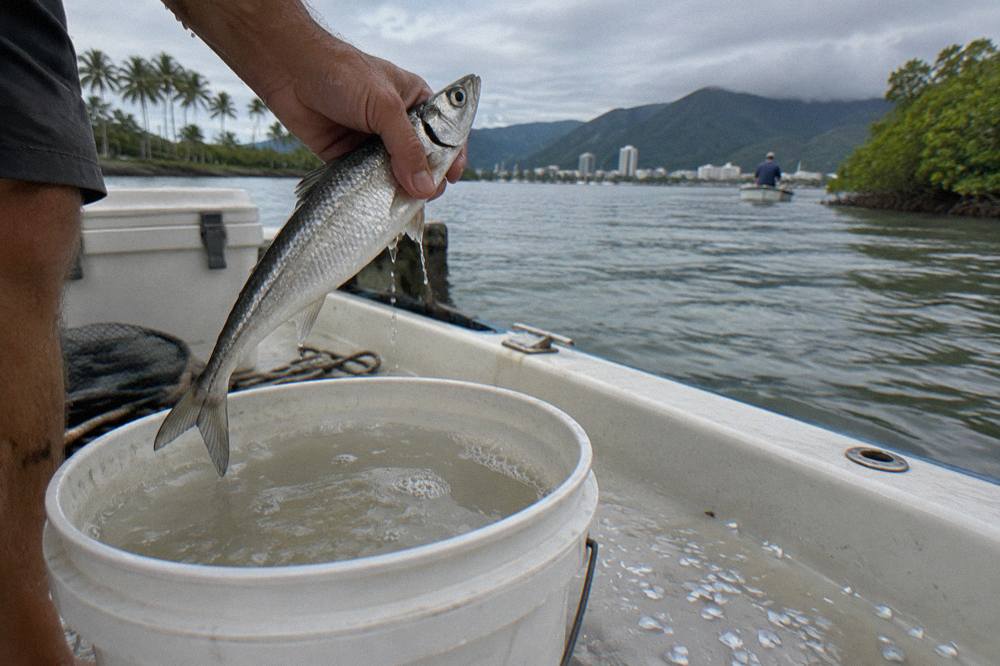
Live bait for barramundi in this region typically means small mullet, herring, gar or live prawns, whatever is available and legal to use in the tidal systems. The principle is simple: the bait behaves like food, and a barra that has sat under a mangrove root all day will hit a live fish that swims into its strike zone. Guides hook live baits so they swim naturally, fish them close to structure, and let the tide carry them past the likely lies. The trade-off is effort. Live bait needs to be caught or bought, kept alive, handled carefully and re-baited often, and it does not suit every visitor who just wants a few relaxed hours on the water.
Dead bait is the low-effort alternative, and it is not a poor cousin. Fresh dead prawns, mullet fillets or pilchards fished on the bottom near a snag or a rock bar account for plenty of barramundi, particularly at dusk and dawn when the fish move onto the flats and edges to feed. Fresh matters more than presentation: a bait that has been frozen and thawed twice has lost the smell and texture that carries in estuary water. The weakness of dead bait is coverage. You put it in one spot and wait, and if no barra is holding there, nothing happens, which is why patient anglers love it and restless ones do not.
| Presentation | Best Cairns conditions | Main strength | Main trade-off |
|---|---|---|---|
| Live fish (mullet, herring, gar) | Dirty water, warm months, around snags | Triggers ambush strikes at close range | Needs keeping alive, more effort |
| Live prawns | Clear water, creek mouths, run-off tides | Works when fish are fussy | Fragile, hard to keep for hours |
| Fresh dead bait | Dusk and dawn, bottom fishing near structure | Simple, no action needed | Waits for the fish to find it |
| Lures | Clear water, active fish, covering ground | Finds fish instead of waiting | Needs technique, less forgiving |
One honest note on claims: no reliable success rate exists comparing bait types for Cairns barramundi, and any figure you see quoted online should be treated with suspicion. Fishing reports for the region describe good estuary action in the Trinity Inlet, Daintree and Russell and Mulgrave systems, with barramundi alongside mangrove jack, grunter, queenfish, trevally, estuary cod and flathead, but nobody counts how many of those fish came from bait versus lures. Pick the presentation that suits the day and your own patience, not a percentage you found on a forum. That same skepticism serves you well offshore, where our breakdown of how far out the black marlin grounds actually sit from Cairns sorts what skippers know from what forums claim.
What Bait And Tackle Do Cairns Fishing Trips Supply?
The guided trips on this site supply the basics in the ticket price: the Trinity Inlet estuary charter includes rods, reels, bait and tackle, plus bottled water and an esky with ice, and the Hook-A-Barra farm sessions include tackle and lures, with the one-hour listing also naming bait. The self-drive boat hire listings are the exception, where bait is sold as an extra on the AUD listings.
This is the difference that decides how much bait strategy actually matters to you. On a guided estuary charter you turn up at the Cairns Marlin Marina at 6.30am, meet the skipper at Finger D berth 2, and the boat already carries the bait, the tackle and the local knowledge of where to put it. The listing for the morning estuary charter, from AUD 150 per person for a 4.5 hour trip with a maximum of six guests, states that rods, reels, bait and tackle are supplied. Food is not, so eat before you board. The skipper decides the bait and the rig on the day based on the water, and your job is to listen and cast where told, which for most visitors is a far better deal than guessing at a tackle shop the night before. The same hands-off arrangement holds offshore, and a guide to the best bait for catching marlin off Cairns explains how the game boat crew rigs the skip baits and lures so you can just focus on the fight.
The farm sessions at Wonga Beach work differently but on the same principle. Hook-A-Barra is a stocked-pond catch and release experience at the Daintree Saltwater Barramundi Farm, about 1.5 hours north of Cairns, and the sessions are designed for people with no gear and no bait experience. The 1.5 hour listing, from AUD 70 per person, includes tackle, lures and an intro from the guides, plus access to the barramundi viewing tanks. The one-hour listing from USD 54.52 per person, same operator and same ponds, names rod, tackle, lures and bait provided, and all fishing is catch and release. In stocked ponds full of barra, the presentation is simplified for you, and the guides on hand set you up.
The self-drive boat hire options are where bait becomes your own problem. Cairns Boat Hire, at Berth A1 at the Marlin Marina, rents shaded tinnies from AUD 189 per group of up to four and pontoons from AUD 249 per group, with the boat and fuel included, but on the AUD listings the rods, esky, bait and ice cost extra. You bring your own food and drink too. That suits anglers who already own tackle and have a bait plan, and it frustrates those who do not, so read the inclusions before choosing. One reviewer on the USD pontoon listing reports being given a smaller boat than booked, so confirm inclusions and boat type with the operator when you book.
The estuary charter is the one to pick if you want the bait question answered for you on wild water. The trip fishes Trinity Inlet on a 19-foot river boat, the listing does not name target species, so go expecting estuary fishing rather than a promised barra count, and the gear is in the price. You can read more about the trip in the guide to estuary fishing around Cairns, or see the wider picture in Cairns fishing charters compared.
When Do Lures Beat Bait For Barramundi?
Lures beat bait when barramundi are actively feeding and the water is clear enough for them to see, which around Cairns means the build-up months of October and November and the run-off from March to May, when fish chase baitfish hard. Lures also let you cover water, working snag edges and rock bars until you find a fish instead of waiting in one spot. Since lure fishing pays off most when the fish are switched on, check the month by month barramundi season guide for Cairns before you lock in your dates.
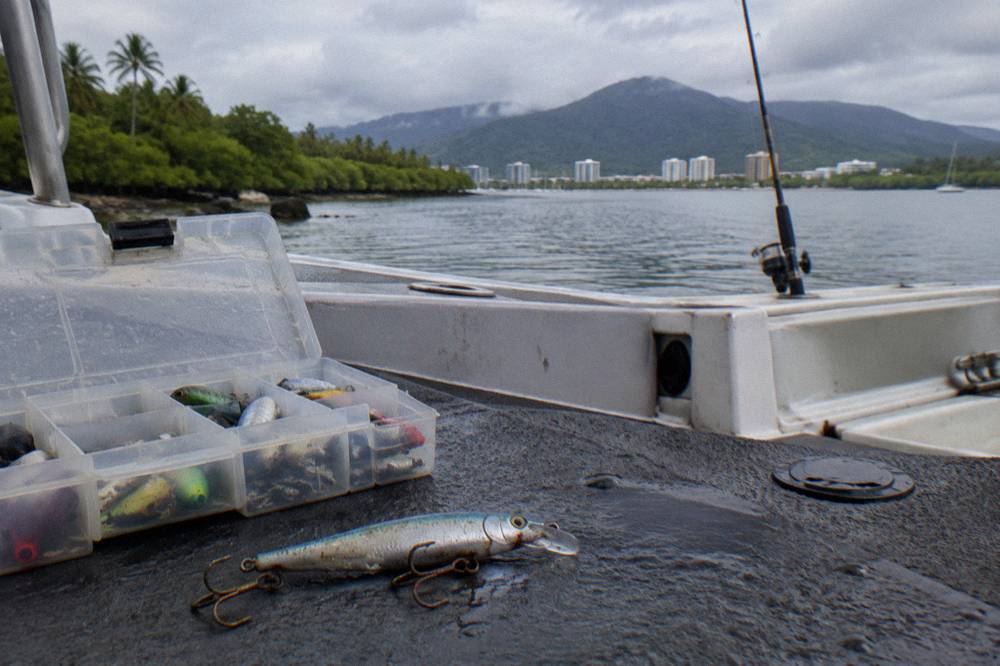
The classic Cairns lure for barramundi is a hard-bodied diver or a shallow-running lure worked along the edges of mangroves, over rock bars and through the mouths of small creeks, retrieved with a pause-and-wind action that imitates a wounded baitfish. The advantage over bait is control: you choose the depth, the speed and the territory, and a barra that is in a hunting mood will travel to hit a lure passing its lie. In the clearer water of the dry season, and in the warmer months when metabolism is high, that hunting mood is common.
Bait regains the advantage in the opposite conditions. After heavy rain, when the rivers run dirty and cold, barramundi feed less aggressively and rely on scent and vibration, and a fresh dead bait or a live fish sitting in their face will outfish the best lure in the box. The same applies in the middle of the day in the wet season, when fish are sulking deep in the snag. Experienced locals carry both options, and the switch from lure to bait during a session is routine, not a defeat.
The lure question has its own dedicated reading if you want to go deeper: the site's guide to choosing barramundi lures covers the types in detail. The short version for bait-minded anglers is that lures reward practice, and a visitor with one morning on the water usually gets more fish from bait supplied by a guide than from a lure they learned to cast yesterday. That is a fair, honest reason to let the charter make the choice.
What Rules Affect Barramundi Bait Fishing Around Cairns?
Barramundi must measure between 58 and 120 cm to be kept, with a possession limit of 5 per person or 10 per boat when two or more people are aboard, and the east coast closed season runs from 1 November to 31 January, when barramundi cannot be targeted at all in tidal or fresh waters, including for catch and release.
The size rule matters to bait fishing in a specific way. Barramundi caught on bait from a snag are often deep-hooked, and a fish outside the 58 to 120 cm window must go back, so handling it quickly and gently decides whether it survives. The slot is generous in the middle but protects both juveniles under 58 cm and the big breeding females over 120 cm. The official limits are published by the Queensland government on its tidal waters fishing rules page, which is the page to check before any trip.
The closed season is the bigger constraint on planning. From 1 November to 31 January the east coast barramundi closure applies to tidal waters and to fresh waters, and the rule is not just about keeping fish: you cannot target barramundi at all in that window, not even for catch and release, because the stress of capture may prevent spawning. The dates are published by the Department of Primary Industries on its seasonal closures page. If your Cairns trip falls between November and January, plan around it: the estuary charters still fish for mangrove jack, grunter, queenfish, trevally, estuary cod and flathead, which are all on the bite in the local systems, and the stocked ponds at Hook-A-Barra are a separate question of farm dates, which the listing is the place to confirm.
Lake Tinaroo is the one exemption worth knowing. The dam is exempt from the closed season, so barra can be targeted there year round, but anyone 18 or older needs a Stocked Impoundment Permit, which costs AUD 13.60 for a week or AUD 64.58 for a year, with a concession rate of AUD 46.45. There is no self-drive or charter product for Tinaroo on this site's roster, so it is a self-organised trip, but it is the legal answer to a wet-season barra itch.
| Rule | Detail | Where it applies |
|---|---|---|
| Barramundi size slot | 58 to 120 cm only | All Queensland tidal waters |
| Barramundi possession | 5 per person, or 10 per boat with 2 or more aboard | Tidal waters |
| Closed season | 1 November to 31 January, no targeting at all | East coast tidal and fresh waters |
| Stocked Impoundment Permit | AUD 13.60 a week, needed from age 18 | Lake Tinaroo and listed dams |
| Licence for tidal water | None required | Cairns estuaries and the reef |
No fishing licence is needed for tidal waters or the reef in Queensland, so bait choice is the only thing you need to organise for an estuary charter. The permit question only arises at the stocked dams.
Where Does Bait Work Best Around Cairns?
Trinity Inlet, the Barron River, the Mulgrave and Russell systems and the Daintree River are the bait-fishing heartland around Cairns, with barramundi holding around snags, rock bars and mangrove edges alongside mangrove jack, grunter, queenfish, trevally and estuary cod. The noted peaks are the run-off from March to May and the build-up from October to November.
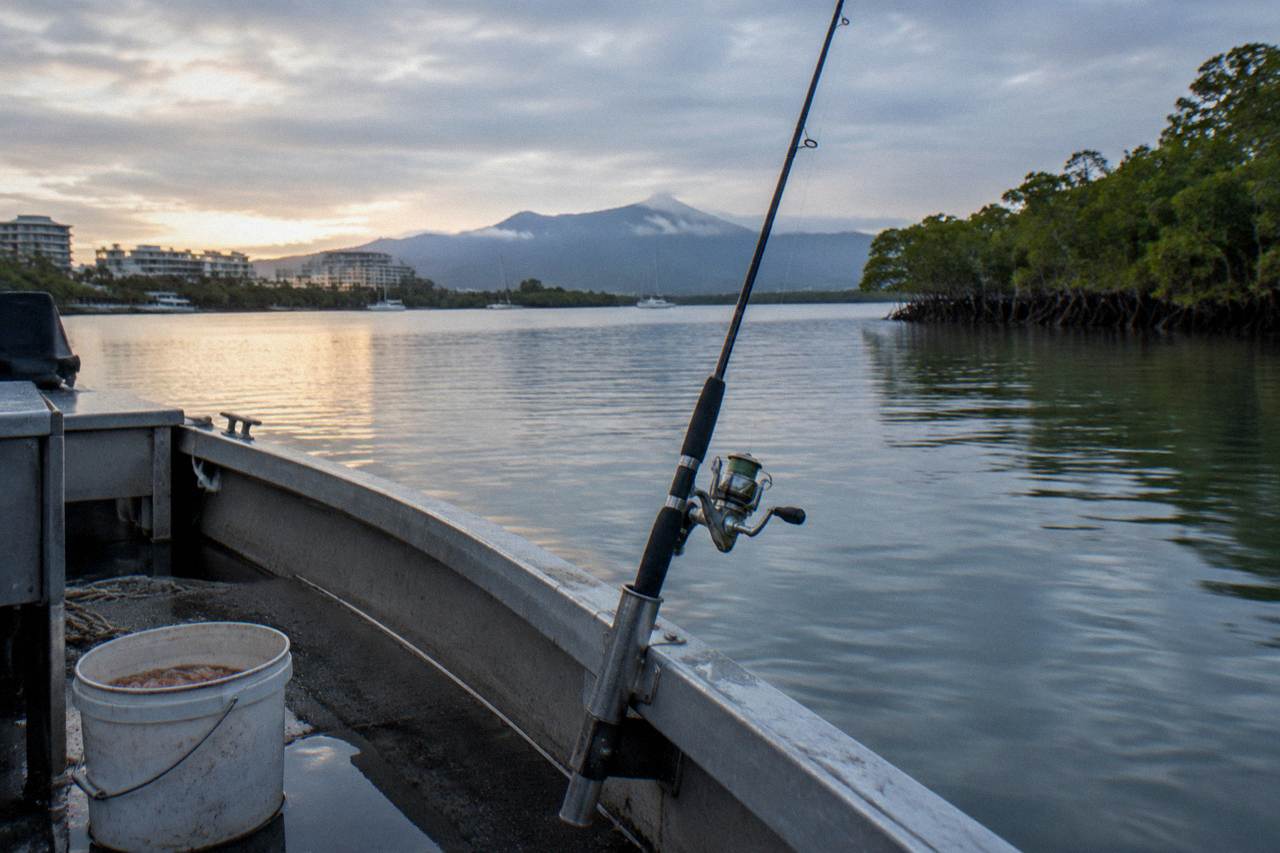
Trinity Inlet is the closest and the easiest, which is why the estuary charter runs there. It is a maze of creeks and mangrove channels minutes from the Marlin Marina, and bait fished near the snag lines and creek mouths covers the holding water without a long run. The Daintree, about an hour and a half north, is the famous barra river, and the Russell and Mulgrave south of Cairns produce fish in the same style. The common thread is structure: barra bait fishing is about putting the offering close to timber, rock or a draining creek mouth and letting the tide do the work.
The seasonal rhythm shapes where and when bait beats everything. In the run-off, from March to May, the wet-season floods recede and barramundi gather at creek mouths to feed on everything being washed out, which is bait fishing at its most productive. In the build-up, October and November, the heat builds before the first rains, fish feed aggressively and both bait and lures work. The closed season then removes barra from the equation entirely for three months, which is exactly why the jack, grunter and queenfish fishing carries the estuary trips through the summer.
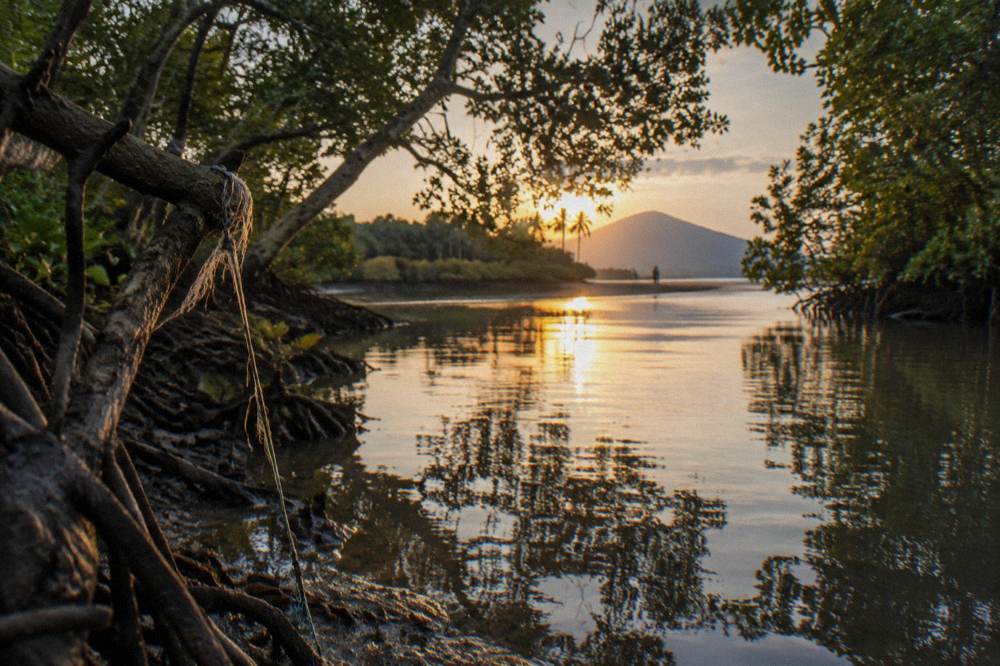
One safety point belongs here, because bait fishing keeps you near the water's edge and near fish scraps. Far North Queensland is crocodile country, and no water body in the region should be assumed to be free of them. The Queensland government's guidance is to obey signs, stand well back from the water's edge, never wade in to retrieve a snagged rig, never clean fish or dump scraps near the water or at boat ramps, and take extra care at dusk, dawn and after rain or high tides. The official crocodile facts page is worth a read before any shore-based fishing. On a charter the skipper manages this; from a hired boat it is your responsibility.
Is The Hook-A-Barra Pond Session A Good Way To Practise?
Yes, the stocked-pond sessions at Wonga Beach are the most reliable way around Cairns to actually hook a barramundi on supplied tackle, because the ponds are stocked with fish and the guides set up the rig for you. It is a farm experience, not wild estuary fishing, and it is honest about that, but as bait and lure practice before a wild-water trip it works.
The 1.5 hour session, from AUD 70 per person, rated 4.5 from 25 reviews, includes tackle, lures and an intro from the guides, plus access to the barramundi viewing tanks where you can see the fish you are fishing for. The one-hour listing from USD 54.52, rated 4.9 from 293 reviews, the deepest review pool on this site's roster, names rod, tackle, lures and bait provided, runs with a maximum of 18 travellers, and is the same operator and same ponds with a different review pool and group size. Both are catch and release, and whole fish or fillets can be bought at the farm on the one-hour listing if you want to taste barramundi afterwards.
For a bait-focused reader the value is simple: a stocked pond removes the variables that make wild barra hard. The fish are there, the water is calm, the guides hand you a working rig and correct your technique on the spot. A visitor who has never set a hook can learn the strike and the fight in an afternoon, then take that confidence to a wild estuary charter. The session does not teach you where the snags are in Trinity Inlet or how to read a run-out tide, and it does not pretend to. There is no Cairns pickup: the farm is at Lot 3 Vixies Rd, Wonga Beach, and guests make their own way, about 1.5 hours north of Cairns. The only pickup anywhere on this site's roster is the Port Douglas lunch session, which collects from Port Douglas hotels, not Cairns.
The pond sessions also sidestep the closed season question in a way no wild barra trip can, though the farm's own session dates are the thing to confirm on the listing. If you are set on a wild fish, the estuary charter remains the honest route: bait and tackle supplied, wild water, no species promised, and a skipper who makes the call on the day. If you want a deeper look at the species itself, the guide to barramundi fishing around Cairns covers the wild-water side in full, and this site, Fishing Tours Cairns, exists to line up the two honestly.
Common Questions About Barramundi Bait In Cairns
What Is The Best Bait For Barramundi In Cairns?
Live bait such as small mullet, herring or live prawns is the strongest all-round option in the Cairns estuaries, with fresh dead bait close behind in dirty water and lures better when fish are feeding actively in clear water. On a guided trip the choice is usually made for you: the Trinity Inlet estuary charter supplies bait and tackle, and the Hook-A-Barra pond sessions supply tackle and lures, with the one-hour listing also naming bait provided.
Do I need to bring my own bait on a Cairns fishing charter?
No, not on the guided trips listed here. The morning estuary charter includes rods, reels, bait and tackle in the AUD 150 per person price, and the Hook-A-Barra sessions include tackle and lures, with bait named on the one-hour listing. The self-drive boat hire listings are the exception, where bait is sold as an extra on the AUD listings, so bring your own or arrange it with the operator.
Can I fish for barramundi in Cairns between November and January?
No. The east coast barramundi closed season runs from 1 November to 31 January, and in that window you cannot target barramundi at all in tidal or fresh waters, not even for catch and release. Lake Tinaroo is exempt and can be fished year round with a Stocked Impoundment Permit, and the estuary charters fish for other species through the closure.
Are lures or bait better for beginners?
For a visitor with limited time, bait supplied by a guide is the easier path, because it needs less technique and the skipper sets the rig. Lures reward practice and cover more water, but the learning curve is real. A stocked-pond session at Hook-A-Barra, with tackle and lures included and guides on hand, is a low-pressure place to practise either one.
What size barramundi can I keep around Cairns?
Barramundi must measure between 58 and 120 cm, with a possession limit of 5 per person or 10 per boat when two or more people are aboard. Anything outside that slot goes back, and during the closed season nothing may be targeted at all. The Hook-A-Barra pond sessions are catch and release, so nothing is kept there.