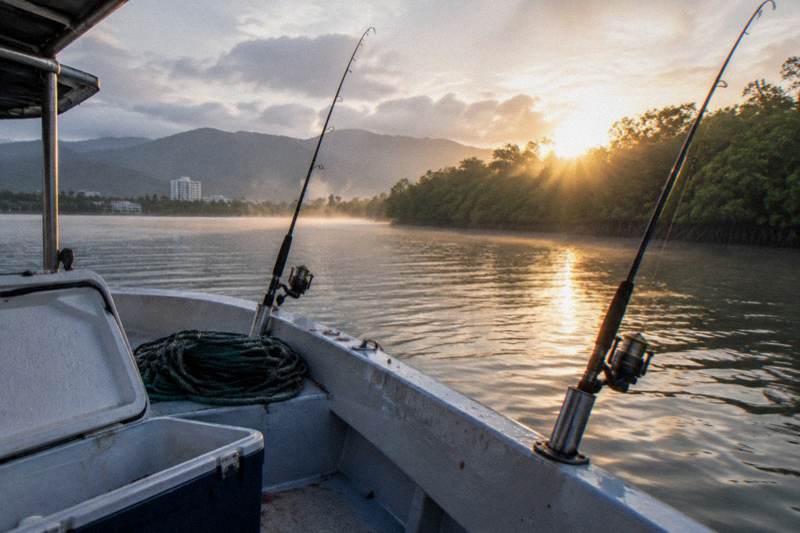
Estuary And Creek Fishing From Cairns
Estuary fishing is the calm-water side of Cairns fishing: mangrove creeks, inlet channels and river mouths where the wind barely matters and the tide decides everything.
Short answer
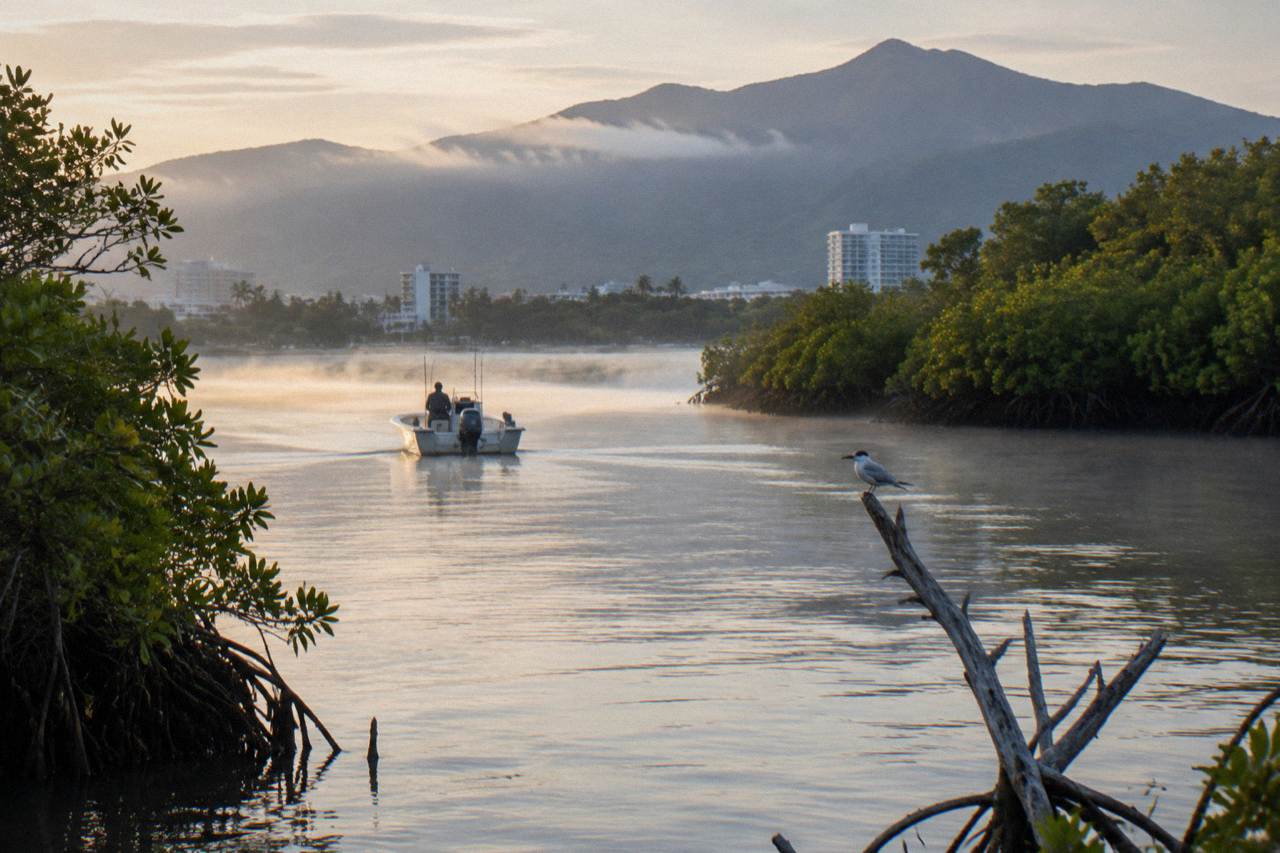
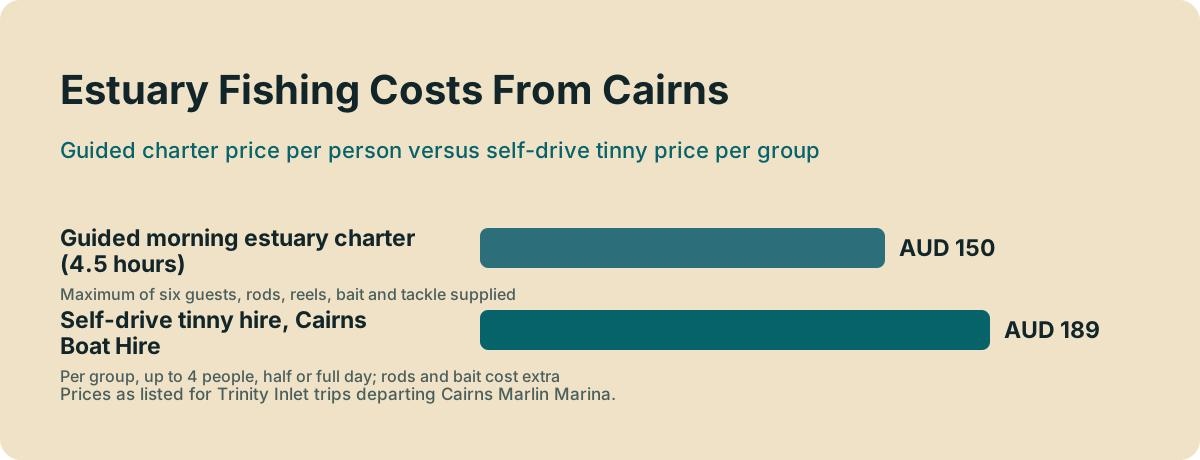
Cairns estuary fishing centres on Trinity Inlet, a sheltered mangrove waterway a short walk from the city. A guided morning charter runs 4.5 hours from AUD 150 per person with gear supplied, or self-drive tinnies start at AUD 189 per group of up to 4. Expect barramundi in season, mangrove jack, grunter, queenfish and trevally.
Estuary fishing around Cairns means mangrove creeks, inlet channels and river mouths, fished from small boats close to shore. Trinity Inlet sits immediately behind the city, and the Barron, Mulgrave, Russell and Daintree systems all sit within reach of a day trip. It is the calm-water answer to the reef: wind matters less, tide matters more, and the fish that live here, barramundi, mangrove jack, grunter, queenfish, trevally, estuary cod and flathead, are among the most prized in tropical Australia.
This guide covers what estuary fishing here actually involves, the rules that apply to the main species, how to fish these waters safely around crocodiles, and the honest choice between a guided charter and a self-drive boat. The calm water is real, but it is not a swimming pool: tide and weather still shape every trip, and the barramundi season closes each summer.
What Is Estuary Fishing Around Cairns?
Estuary fishing is fishing the semi-sheltered, tidal waters where rivers and creeks meet the sea: in Cairns that mainly means Trinity Inlet plus the Barron, Mulgrave, Russell and Daintree systems. It is done from small boats in water measured in metres, not ocean swells, and it targets salt-tolerant species that live around mangroves, mud flats and channel edges. The fishery runs year round, apart from seasonal closures on individual species.
The distinction matters for trip planning. A reef charter out of Cairns runs about 90 minutes offshore and spends the day in open water, which is fine in good conditions and punishing in a blow. An estuary trip stays inside the inlet or up a river, where the mangrove fringe knocks down the wind and the worst you usually face is a short chop across a channel. That is why estuary trips are the default recommendation for families, first-timers and anyone whose stomach does not trust the ocean.
The trade-off is selectivity. Estuary fishing is tide-driven in a way reef fishing is not: barramundi and jack feed hardest around dawn, dusk and the turn of the tide, and a session fished at dead low in the middle of the day can feel empty even when the fishery is healthy. Guides earn their fee partly by reading that clock, and the Cairns fishing tides guide covers how to do it yourself if you are hiring a boat.
There is also a seasonal rhythm on top of the daily one. Local reporting marks the run-off from March to May and the build-up from October to November as the noted peaks for estuary action around Cairns, with fish feeding hard before and after the wet season proper. The southeast trade months from roughly May to October are the drier, more predictable window for visitors. If barra are your main target, our month by month guide to barramundi seasons in Cairns covers which months deliver and when the closed season shuts the wild fishery down.
Trinity Inlet: Cairns' Sheltered Water Fishery
Trinity Inlet is a mangrove-lined tidal system that begins almost at the Cairns Esplanade, and it is the most accessible estuary fishery in Far North Queensland. Charters depart from the Cairns Marlin Marina at 1 Spence St, a short walk from the CBD, and the fishing grounds are minutes from the berth rather than an hour offshore. The inlet produces barramundi in season, mangrove jack, grunter, queenfish, trevally, estuary cod and flathead. If the calm water of the inlet has you wondering about the other end of the spectrum, how far offshore the Cairns black marlin grounds really are covers what that run out to the outer reefs actually involves.
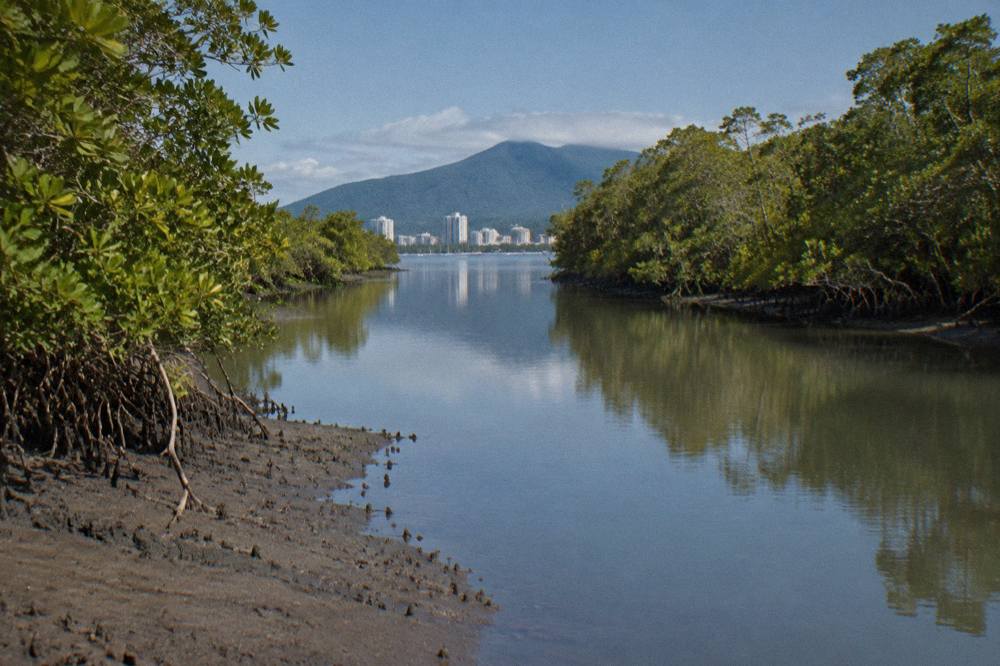
The inlet's geography explains its appeal. A deep shipping channel runs down the middle toward the port, and a maze of creeks and mudflats branches off it, everything from 10-metre holes to water skinny enough to see crab shells on the bottom. Structure is everywhere: snaggy banks, rock walls, bridge pylons and mangrove roots, which is exactly the country jack and barra hold in. Because the whole system is protected from the southeast trades, it fishes on days when the reef fleet stays tied up.
The guided option here is a 4.5-hour morning estuary charter that meets at 6.30am at the marina and runs a 19-foot river boat with a maximum of six guests. It is rated 4.6 from 22 reviews, a small pool but a consistent one, and it costs from AUD 150 per person. Rods, reels, bait and tackle are supplied, along with bottled water and an esky of ice, but no food, so bring breakfast. The listing does not name target species, which is honest: an estuary charter fishes the inlet, and what bites depends on tide, season and luck. There is no hotel pickup; every Cairns departure on this roster is self-arrival at the marina.
The self-drive alternative fishes the same water. Cairns Boat Hire operates from Berth A1 at the same marina, renting shaded tinnies that hold up to 4 people from AUD 189 per group, for half or full day. The driver must be 18 or older with a driver's licence; no marine licence is needed per the listing. Boat hire and fuel are included, but rods, bait, ice and an esky cost extra, so the price gap against the charter narrows once you add gear. Hire covers just the boat and fuel; the safety briefing and fishing-spot tips come with the pontoon listing, which matters, because the inlet has shipping traffic, crocodiles and plenty of snags.
What You Can Catch In Cairns Estuaries
The core estuary catch around Cairns is barramundi (in open season), mangrove jack, grunter, queenfish, trevally including giant trevally, estuary cod and flathead, with threadfin and bream also in the mix. Mud crab are taken in the same waters. Barramundi are closed to all targeting, including catch and release, from 1 November to 31 January in tidal and most fresh waters.
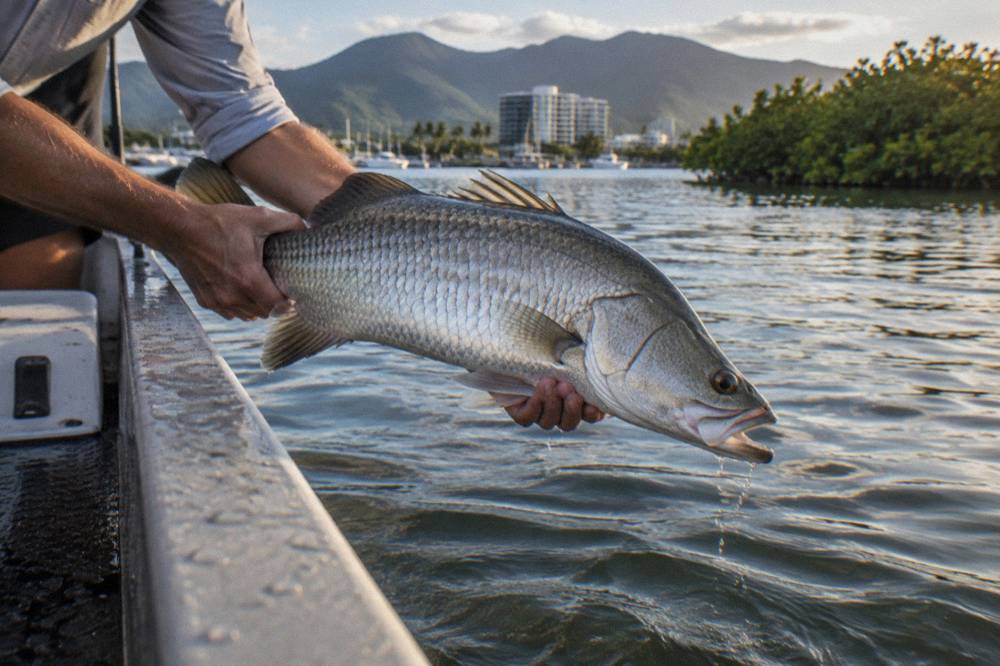
Barramundi are the headline species, and they are the hardest earned. A legal fish must measure between 58 and 120 cm, with a possession limit of 5 per person or 10 per boat when two or more people are aboard. The closed season is stricter than most visitors expect: you may not even target barramundi between 1 November and 31 January, because the stress of capture can prevent spawning. Lake Tinaroo is the exemption, a stocked impoundment where barra fishing runs year round with a Stocked Impoundment Permit from age 18 (AUD 13.60 a week, AUD 64.58 a year, AUD 46.45 concession). The rules are published on the official Queensland closures page.
Mangrove jack are the estuary's other glamour fish: aggressive, hard-pulling reef-and-mangrove predators that hit hard near structure. They run a 35 cm minimum and a limit of 5. Grunter (javelinfish), queenfish and trevally are the reliable bread-and-butter species that keep sessions lively when the barra sulk, and estuary cod and flathead round out the bycatch. Mud crab pots work in the same creeks: males only, minimum 15 cm across the widest part of the shell, 7 per person or 14 per boat, and no taking of crabs missing a shell or claws only.
For visitors chasing a barra pull without the closed-season complications, the stocked-pond barramundi farm at Wonga Beach offers an honest middle path: catch-and-release pond sessions where fish are far likelier to bite than in wild water, with tackle, lures and a guide intro included. It is a farm experience, not wild fishing, and it should not be sold to yourself as either. But as a wet-season or family fallback it works, and the barramundi fishing in Cairns guide goes deeper on the species itself.
Rules, Sizes And Seasons For Estuary Species
The four rules that most affect a Cairns estuary trip: barramundi 58 to 120 cm, limit 5 per person or 10 per boat, closed 1 November to 31 January; mangrove jack 35 cm minimum, limit 5; mud crab 15 cm minimum, 7 per person or 14 per boat, no females; no fishing licence is required in tidal waters. Charters are bound by the same size and possession limits as private fishers. If your trip also takes you out to the reef, our guide to reef fish limits per angler in Queensland covers the separate rules that apply beyond the estuaries.
| Species | Minimum size | Possession limit | Closed season |
|---|---|---|---|
| Barramundi | 58 cm min, 120 cm max | 5 per person, 10 per boat | 1 Nov to 31 Jan (tidal and most fresh waters) |
| Mangrove jack | 35 cm | 5 | None |
| Mud crab | 15 cm (widest part of shell) | 7 per person, 14 per boat | No females, ever |
| Black jewfish (east coast) | 75 cm | 2 per person, 4 per boat | 1 Nov to 31 Jan |
Two things surprise visitors. First, the no-targeting rule during the barramundi closure: it is not enough to release the fish, you must not fish for them at all, and charters comply by switching what they chase. Second, licence-free does not mean rule-free. No recreational licence is needed in tidal waters, and a charter supplies the licensed vessel, but size limits, possession limits and closures all bind you personally, and Fisheries Queensland checks them. The full limits sit on the Queensland tidal waters rules page.
If your estuary day doubles as a reef day, note that coral reef finfish carry their own closures: two five-day spawning windows, 8 to 12 October and 6 to 10 November in 2026, during which no reef finfish may be taken, and these bind charter boats as well as private anglers. The visitor-focused summary is in the Queensland fishing rules for visitors guide.
Crocodile Safety On Cairns Estuary Waters
Cairns estuaries are saltwater crocodile habitat, and every estuary trip, guided or self-drive, should follow the Queensland Government advice: obey warning signs, stand well back from the water's edge, never wade in to retrieve a lure, and never clean fish or dump scraps near the water or at boat ramps. Extra care is needed at dawn, dusk, after rain and after high tides. No water body in croc country is considered free of crocodiles.
This is not a reason to skip estuary fishing. It is a reason to fish it from a boat, sensibly. A charter with a local skipper removes almost all of the judgment calls: the operator knows which creeks to treat with respect and keeps arms and legs inside the boat. On a self-drive hire the responsibility shifts to you, which is why the hire crew's briefing is worth listening to rather than enduring.
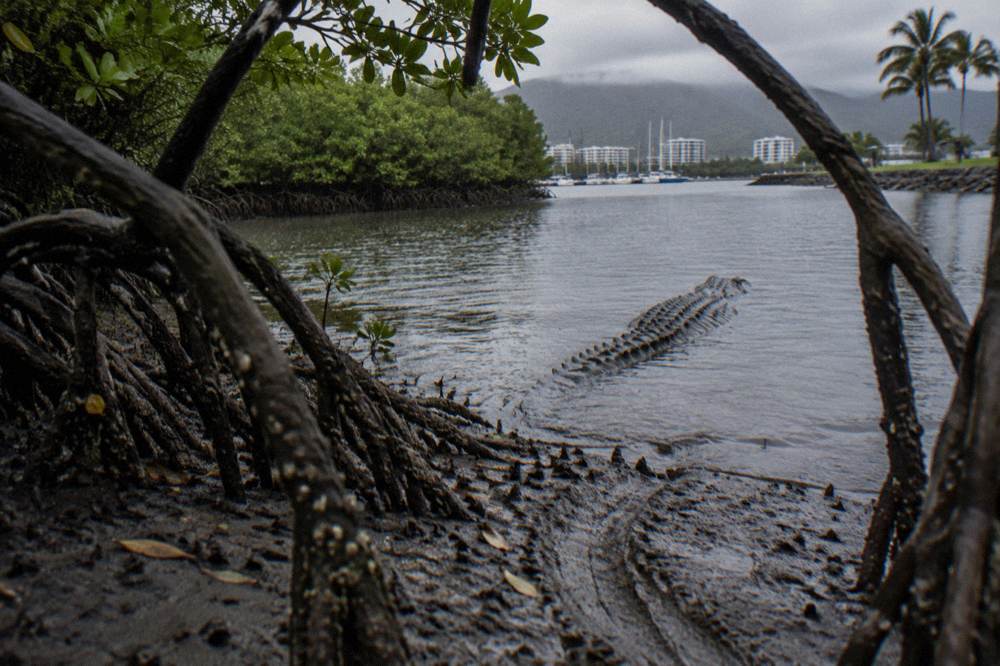
The specific behaviours that get people into trouble are consistent: fishing from the same bank at the same time each day (crocodiles learn patterns), standing close to the edge to land a fish, and handling bait or cleaning catch near ramps. The Queensland advice recommends standing at least 5 m back from the edge when bank fishing, using a solid object like an esky as a barrier, and staying well clear of slide marks and nesting mounds. If you are fishing from shore rather than a boat, the free spots and the local cautions are covered in the free fishing spots around Cairns guide.
Report crocodile sightings through the QWildlife app or on 1300 130 372. On board, keep everything inside the gunwales, and if a lure goes into a snag, break it off rather than reaching for it.
Guided Charter Or Self-Drive Boat On The Inlet?
A guided charter from AUD 150 per person suits first-timers, families and short stays: gear, local knowledge and fish handling are included and the skipper makes the calls. Self-drive hire from AUD 189 per group of up to 4 (tinny) or AUD 249 per group for an 8-person pontoon suits confident anglers who want to fish their own tide, and works out cheaper per head for a full group, once you add the extra gear costs.
The honest comparison comes down to knowledge versus freedom. Trinity Inlet is a big system and the fish hold on specific banks at specific stages of the tide; a skipper who fishes it weekly starts ahead of anyone working from a map. On a 4.5-hour guided morning you also get rods, reels, bait and tackle in the price, which is everything except food. The trade-off is that you fish someone else's plan on someone else's clock.
| Option | Price | Duration | Who it suits | Watch-outs |
|---|---|---|---|---|
| Guided estuary charter | From AUD 150 per person | 4.5 hours, 6.30am meet | Beginners, families, short stays | Max 6 guests, no food supplied, no pickup |
| Shaded tinny hire (up to 4) | From AUD 189 per group | 4 to 8 hours | Confident anglers, small groups | Rods, bait, ice and esky cost extra, driver 18+ |
| Pontoon hire (up to 8) | From AUD 249 per group | 4 to 8 hours | Larger families, mixed groups | Small review pool, 4.8 from 8 reviews, rods and bait optional extras |
The pontoon deserves a specific note. The AUD 249 listing carries a 4.8 rating from only 8 reviews, a pool far too small to call proven, and it sells fishing rods, bait, a BBQ and a skipper as optional extras. The same operator's other pontoon listing, priced in USD at USD 190.48 per group, is the same boat but names rods, bait and a BBQ as included, and one reviewer on that listing reports being given a smaller boat than booked. The practical read: the pontoon is a genuine family option on calm water, but confirm inclusions and boat size with the operator before you pay, and expect to add fishing gear to the bill on the AUD listing.
For groups weighing the pontoon against the smaller boat, the deciding factors are group size and how much fishing you actually plan to do. Eight people on a pontoon with a BBQ is a floating picnic that fishes; four people in a tinny with bait is a fishing trip that picnics afterwards. Neither needs a marine licence, only a driver 18 or older with a driver's licence.
Best Tides And Times For Estuary Fishing
Estuary fishing in Cairns runs on two clocks: the tide and the day. Dawn and the last two hours of the run-in tide are the classic window for barramundi and mangrove jack, dusk is the other peak, and the turn of the tide concentrates feeding across the inlet. On the seasonal clock, the run-off from March to May and the build-up from October to November are the noted peaks.
Tide matters more here than most visitors expect because the inlet's fish feed with the water movement. As the tide runs in, bait is pushed into the creeks and mangroves, and the predators follow; as it drains, they station at creek mouths and channel edges to intercept what is washed out. A session planned around the turn, whichever turn that is, consistently outfishes one planned around a convenient departure time. A guided charter takes care of this silently, which is a real part of what the fee buys.
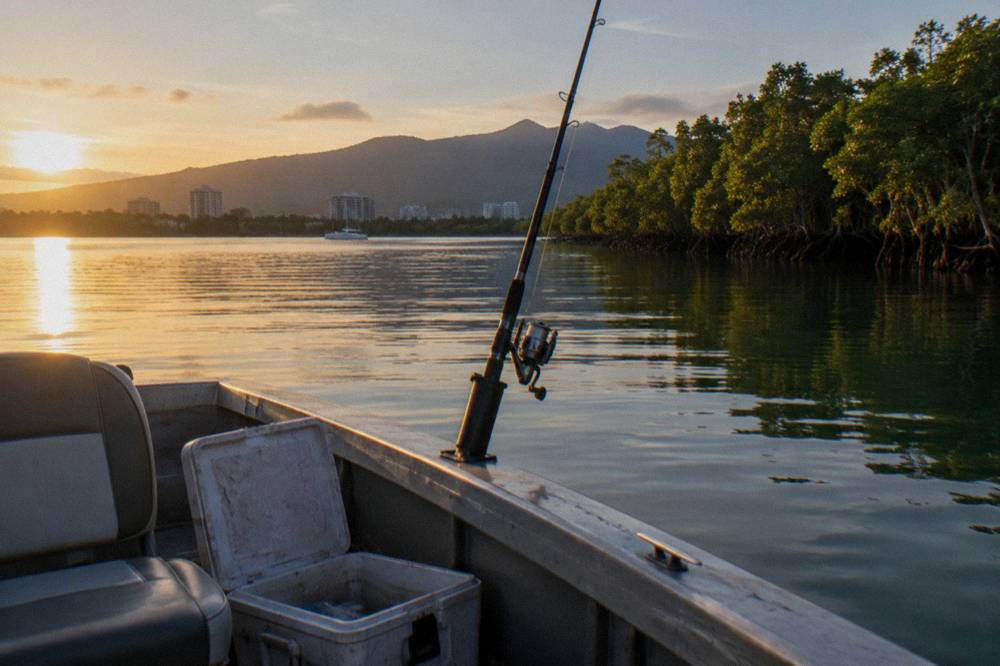
Weather is the second honest caveat. The estuary is sheltered, not indoor. A strong southeast blow can still put a chop across the wider inlet reaches, and wet-season rain from roughly November to April can colour the water and slow the fishing, as well as dumping crocodile-active conditions. The drier trade months, May to October, are the dependable window for visitors, and October's build-up feeds fish hard ahead of the November barra closure. If your dates fall inside the closure, an estuary charter still fishes, just for jack, grunter, queenfish and trevally instead of barra.
Taking Kids And Beginners Estuary Fishing
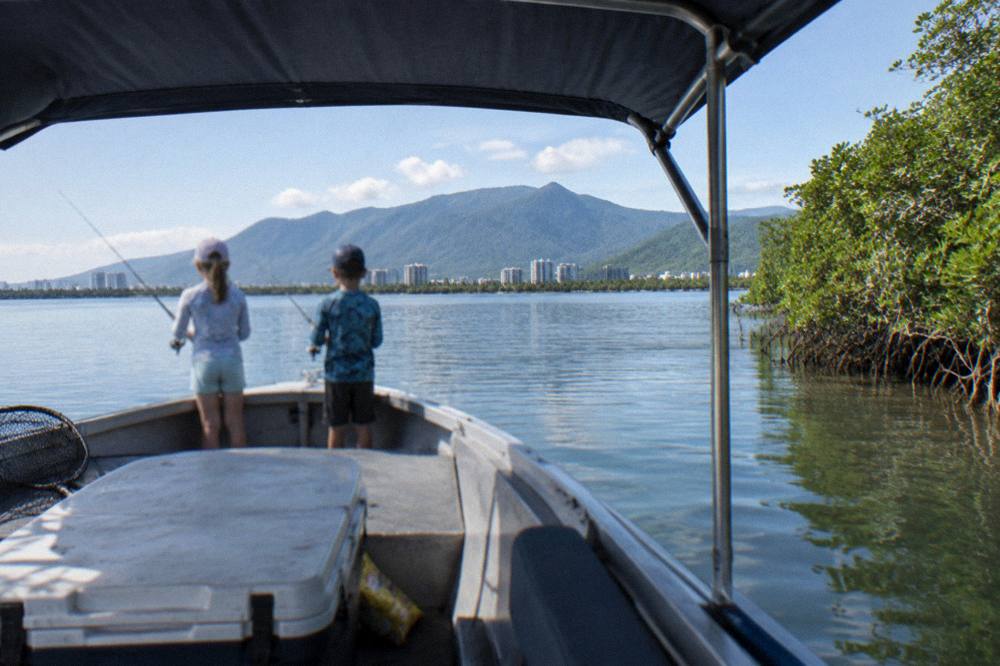
Estuary fishing is the best beginner fishing in Cairns because the water is calm, the boat ride is short, and the bycatch keeps rods bending. A guided charter with a maximum of 6 works for families with school-age kids, and the self-drive pontoon suits families who want to control the pace. For younger children, the stocked-pond barra farm at Wonga Beach, from AUD 70 per person for 1.5 hours, gives a far better chance of a bite than wild water, all catch and release.
The honest framing for families is this: an estuary charter is a fishing trip, not a cruise with a rod holder. Kids who want constant action do best when the bycatch is running, and jacks, trevally and queenfish give that more reliably than barramundi. The 6.30am meet is also early for small children, though it is early for the best reasons: dawn is when the inlet feeds. Bring your own food and snacks, since no charter on this roster supplies meals.
For the youngest anglers, or anyone who wants a far better chance of a bite than wild water offers, the stocked ponds at Wonga Beach are the honest answer, and everything hooked goes back. The 1.5-hour session costs from AUD 70 per person and includes tackle, lures, a guide intro and access to the barramundi viewing tanks, all catch and release. A step up, the 2.5-hour farm activity at USD 88.51 per person, rated 5.0 from 51 reviews, adds a behind-the-scenes farm tour and a barramundi tasting board for a maximum of 8 guests. Neither is wild fishing, and neither picks up in Cairns: Wonga Beach is about 1.5 hours north, and the listing is the place to confirm dates.
Between those poles, the family decision usually lands on water time versus fish certainty. A morning on Trinity Inlet gives kids the real thing, crocodiles, eagles, mudflats and all, with the honest chance of a slow tide. A pond session gives them a barramundi, several of them, and lunch nearby. Plenty of families do one of each across a week, and Fishing Tours Cairns exists to help sort which day is which.
What An Estuary Trip Actually Costs
The guided 4.5-hour Trinity Inlet charter costs from AUD 150 per person with all fishing gear supplied. Self-drive runs from AUD 189 per group of up to 4 for a tinny or AUD 249 per group for an 8-person pontoon, half or full day, with gear as extras. Other operators' listings show shared estuary half days around Cairns at roughly AUD 104 to 150 per person.
Those market ranges are not this site's prices; they are what the wider Cairns market lists, and they frame where the roster sits. At AUD 150 per person with gear included, the morning charter is at the top of the shared half-day band but the only way onto the water with a skipper for less than triple figures of group spend. The self-drive option is cheaper per head the more people you carry: a full tinny of four splits the AUD 189 group price four ways before gear, which is the cheapest guided-adjacent fishing day available from the city, even if the guidance is a map and a briefing.
| Trip | Price | How it is charged | Gear included |
|---|---|---|---|
| Guided estuary charter | AUD 150 per person | Per person | Rods, reels, bait, tackle, water, ice |
| Tinny hire, half day | AUD 189 per group | Per group, up to 4 | Boat and fuel only, rods and bait extra |
| Pontoon hire, half day | AUD 249 per group | Per group, up to 8 | Fuel and life jackets, rods and bait extra |
| Barra pond session (Wonga Beach) | AUD 70 per person | Per person | Tackle, lures, guide intro |
Two cost notes worth keeping. No Cairns trip on this roster includes hotel pickup, so budget nothing for it but expect to make your own way to the marina, which is a short walk from most CBD accommodation and about 7 km from the airport per Ports North. And free cancellation applies across the charter and hire listings compared here, which matters in a tropical climate where a wet-season morning can be written off overnight.
If your appetite outgrows the inlet, the step up is a full day on the reef: a 9-hour shared charter from AUD 395 per person, about 90 minutes offshore, targeting coral trout, red emperor and nannygai with lunch included and the catch cleaned and bagged to take home. The reef fishing in Cairns guide covers that fishery, and the cost comparison guide puts the whole market on one page.
For most visitors the estuary decision is simple. One calm morning on Trinity Inlet with a skipper, or one self-drive day exploring it yourself, delivers the tropical fishing postcard without an ocean swell in sight, and the tide clock, not the ticket price, decides how good it is.
Common Questions About Estuary Fishing In Cairns
Do I need a fishing licence for estuary fishing in Cairns?
No. Recreational fishing in Queensland tidal waters requires no licence, and a charter supplies the licensed vessel. The exception is stocked impoundments such as Lake Tinaroo, where a Stocked Impoundment Permit is needed from age 18.
What fish can I catch in Trinity Inlet?
Barramundi in open season, mangrove jack, grunter, queenfish, trevally including giant trevally, estuary cod and flathead, with threadfin and bream also in the mix. Charters do not promise species; what bites depends on tide, season and conditions.
When is barramundi season closed in Cairns?
The east coast barramundi closed season runs 1 November to 31 January each year. During the closure you may not target barramundi at all, including catch and release, in tidal or most fresh waters. Lake Tinaroo is exempt.
Is estuary fishing in Cairns safe for families?
Yes, with crocodile sense. Fish from a boat rather than the bank, keep arms and legs inside, never clean fish near ramps or the water's edge, and take extra care at dawn, dusk and after rain. No water in croc country is considered crocodile-free.
How much does an estuary fishing charter in Cairns cost?
The guided 4.5-hour morning Trinity Inlet charter costs from AUD 150 per person with rods, reels, bait and tackle included. Self-drive hire starts at AUD 189 per group of up to 4 for a tinny, with gear as extras.
Is estuary fishing calm if I get seasick?
Usually, yes. Trinity Inlet is sheltered from the trade winds and the boat ride is minutes, not hours. It is not flat glass every day, and strong wind or wet-season rain can still roughen the wider reaches, but it is the calmest fishing platform in Cairns short of a pond.